


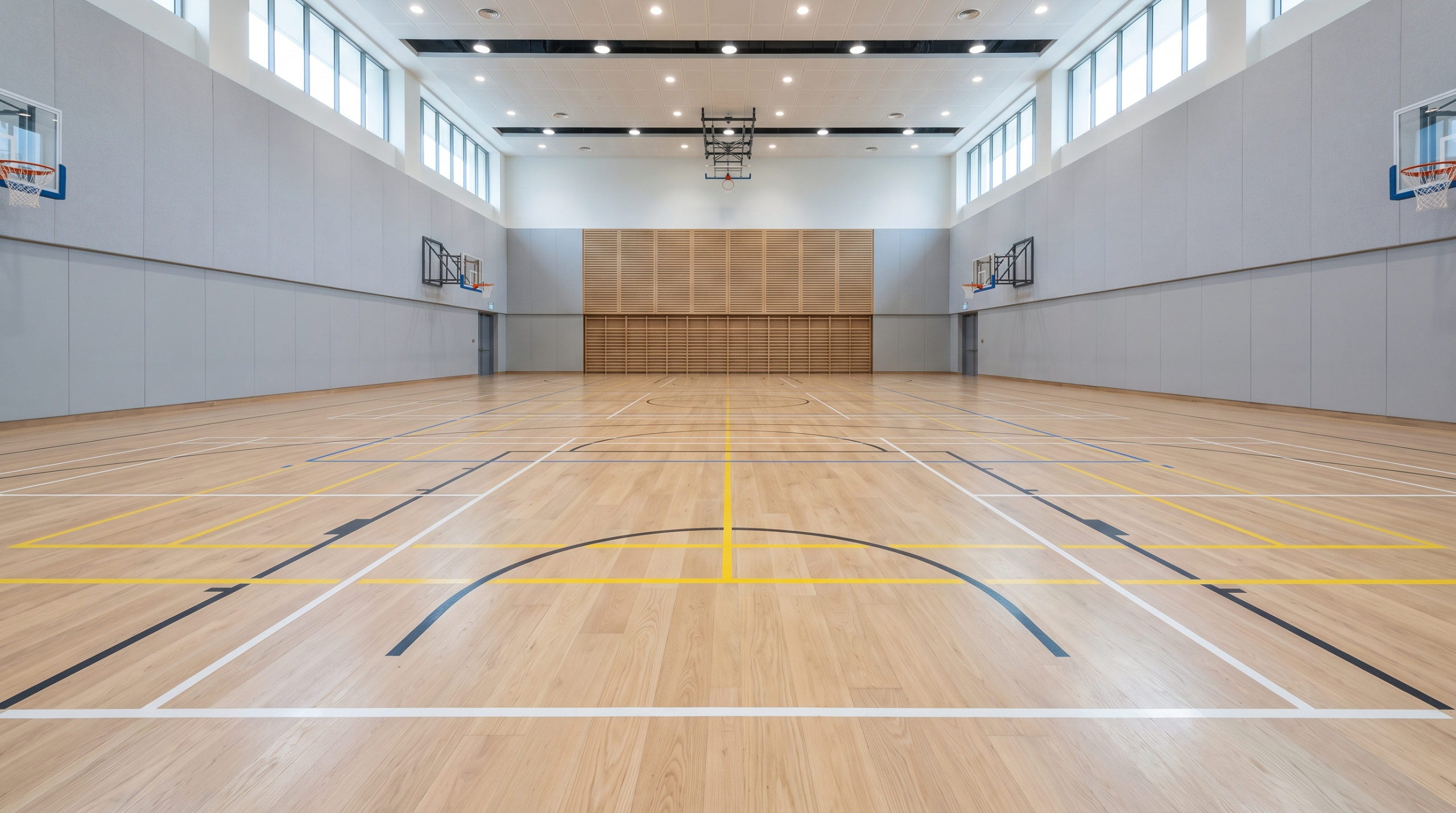
Sports and studio floors need to do more than provide a durable surface. They must support the activities taking place on them, from absorbing impact during court sports to providing suitable cushioning for dance and fitness classes.
In rooms above offices, classrooms or other occupied spaces, the floor may also need to limit the sound of footsteps, jumping and equipment use reaching the rooms below.
These requirements make sports flooring in Singapore a more specialised choice than ordinary residential flooring. The right system depends on the activities, the building structure and the level of performance the space requires.
Part of the confusion is language. Sports flooring in Singapore spans sprung timber systems and synthetic surfaces, and acoustic flooring is a separate requirement that is often needed in the same room. This guide sets out what a performance floor has to do, and how the sports and acoustic requirements fit together.
Wood & Wood supplies and installs sprung and acoustic floor systems, including a white oak timber sports floor system for an international school. The sections below cover what makes a sports floor different, how the build-up works, which system and timber suit which room, where acoustics come in, the compliance a facility will ask for, how to prepare the site, how these floors are maintained, and what drives sustainability and cost.
What makes a sports floor different from an ordinary timber floor?
It has to give: a sports floor absorbs impact and returns energy to protect joints and perform for the sport, which a floor laid flat on screed does not do.
The performance sits in the build-up under the boards, not the boards themselves. That sprung layer is the difference between a floor that plays and a floor that merely looks like a sports hall. The same room may host badminton on a Monday and an assembly on a Friday, so the floor has to hold up to both the sport and everyday foot traffic without being re-specified for each use.
- Shock absorption and area elasticity: the floor deflects under impact to reduce load on the body.
- A sprung subframe of battens, pads or cradles sits beneath the timber surface.
- Consistent ball bounce and controlled slip resistance for the sports played.
- Integrated line marking for the court configurations the hall will host, usually several overlaid, set out as part of the finish rather than added afterwards.
- The sprung subframe sits on prepared concrete, so an existing slab is usually workable once it has been checked for flatness and moisture.
What goes into a sprung sports floor build-up?
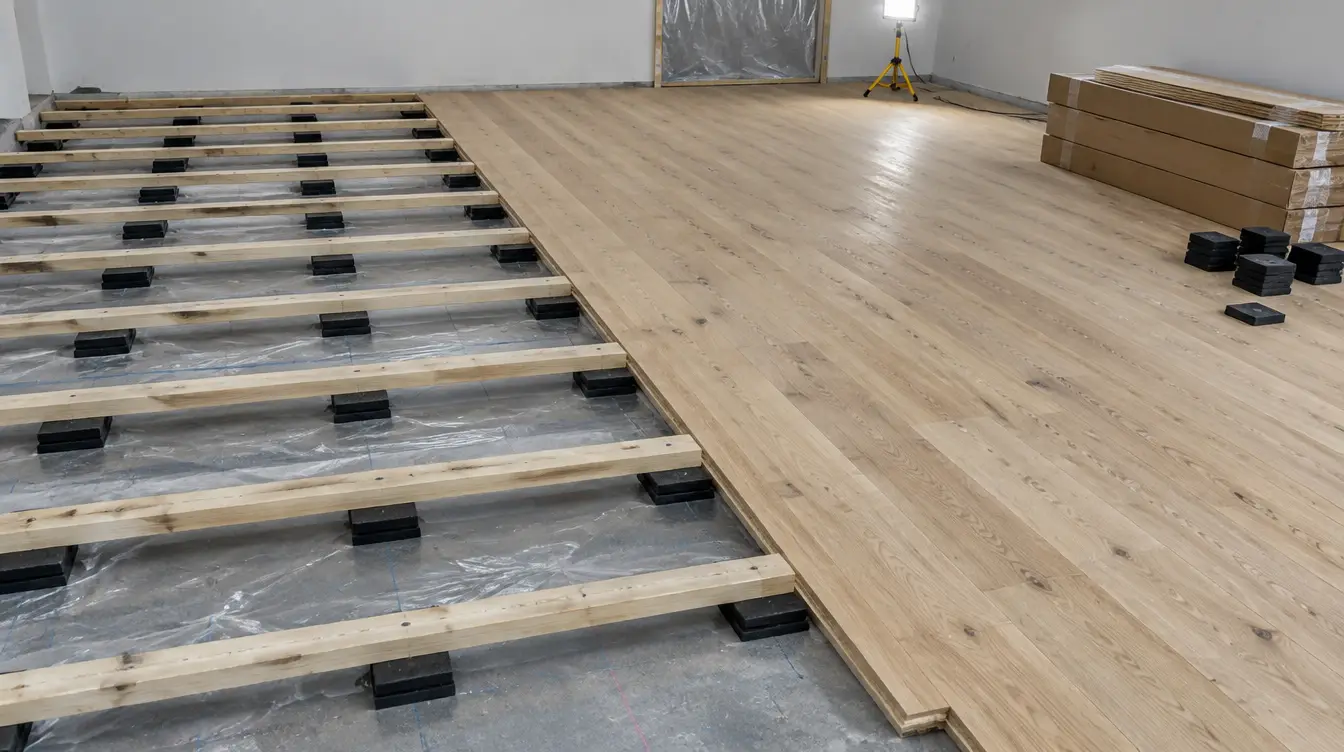
A sprung sports floor is a layered system: a moisture barrier over the slab, a resilient layer of pads or shock pads, a subframe of battens or panels, and the timber playing surface with its sports finish.
Each layer has a job, and the way they are combined decides how the floor behaves under a player’s foot. Sports floor systems are usually grouped by how they deflect under load, and knowing the three types makes supplier quotes much easier to compare.
- Area-elastic: the timber surface spreads the load over a wide area, so a larger section of floor flexes together. This suits multi-purpose halls and court sports where an even ball bounce matters.
- Point-elastic: the floor gives only where the load lands, which provides more local cushioning for aerobics, dance and fitness classes.
- Combi-elastic: a mix of the two, usually an area-elastic surface over a softer layer, for rooms that have to serve both sport and movement classes.
- Build-up height: a sprung system sits deeper than an ordinary timber floor, so the finished floor level, door thresholds and junctions with other floors need to be on the drawings early.
The way the subframe is fixed follows the same logic as the battened and plywood methods in our guide to how solid wood flooring is fixed down, with a resilient layer added to give the floor its spring.
Which sports floor for which room?
A sprung timber system for indoor court sports and multi-purpose halls; a cushioned timber or combi system for studios; a synthetic surface where water or heavy wheeled loads rule timber out.
The room and its sports set the system, and getting that match right at design stage avoids an expensive retrofit later. A floor tuned for basketball will feel wrong under a yoga or martial-arts class, and a studio floor will not survive competitive court play, so the brief has to name the primary use before anything is specified. Most sports flooring in Singapore is specified this way, by the dominant activity in the room. For a school hall the question is usually timber or synthetic: timber for feel and genuine multi-sport performance, synthetic for the lowest maintenance and where wet risk is high.
- Multi-purpose and court halls: a sprung timber sports flooring system, approved to the relevant sport federation standards.
- Dance and movement studios: a sprung or combi system tuned for cushioning and repeated impact.
- Strength and functional gyms: an impact-resistant surface, with timber used only where the loads suit it.
- Wet-risk or termite-exposed areas: a synthetic or polyurethane surface rather than timber.
Which timber species suit a sports floor?
Hard, close-grained species with predictable movement, most often maple, beech and oak, because they give an even ball bounce and stand up to heavy daily use.
Hardness matters on a sports floor, but stability matters just as much in Singapore, where a hall can sit air-conditioned in the day and humid at night. A board that moves too much opens up at the joints and changes how the floor plays.
- Maple: the traditional choice for basketball and indoor courts, with a fine, even grain and a light colour that keeps line markings easy to read.
- Beech: widely used in sports halls, hard-wearing and even in texture.
- Oak: a strong option for school and multi-purpose halls, where the floor also has to look good for assemblies, performances and events.
- Engineered construction: many sports systems use an engineered board, a hardwood wear layer over a stable core, which helps the surface hold its shape in this climate.
White oak is what we supplied for an international school’s sports floor, and you can see more of our completed work in our project references. If the hall doubles as a showcase space, our guide to choosing between white oak, walnut and teak covers how each species looks and wears.
Why is acoustic flooring a separate job from the sprung layer?
In studios, halls and any floor built over an occupied space, an acoustic layer under the system controls impact sound passing to the room below.
The sprung layer and the acoustic layer do different jobs and are specified separately. One protects the user on top; the other protects the room underneath.
- A resilient acoustic layer under the build-up reduces impact sound transmission downwards.
- It matters most for dance studios over classrooms and gyms over offices or retail.
- Specify the impact rating you need, not simply the word “acoustic”.
- Keep the two layers distinct in the specification; the sprung performance and the acoustic isolation are not interchangeable.
What compliance and documentation will a facility ask for?
Facility owners, schools and tender teams want performance test data and compliance documentation at handover, so build those deliverables into the specification.
A sports floor is often bought through a tender, and the paperwork is part of the product. Agreeing the deliverables up front keeps the handover clean.
- Performance to recognised sports-floor criteria: shock absorption, ball bounce and slip resistance.
- Documentation packaged for tender submission and facility handover, with the test method named on each certificate, not just a pass; a result is only comparable when you know what it was measured against.
- Public demand is growing too: under its Sports Facilities Master Plan, Sport Singapore is adding 50 new multipurpose courts over the next five years, which keeps pressure on the supply of compliant halls and courts.
- Confirm line-marking and certification deliverables before work starts, not after.
- File the performance test certificates with the operation and maintenance manual; facility audits and insurers ask for them, and they are hard to reconstruct years later.
What does the site need before a sports floor goes in?
A dry, flat slab, finished wet trades and a space running in the conditions it will be used in, because a sprung floor laid in the wrong conditions can move, squeak or lose performance.
Many of the problems we see on sports floors start before the first board arrives. Halls are often the last area to be finished on a school or community project, which is exactly when the programme gets squeezed.
- Test the slab for moisture and record the reading before materials are delivered.
- Check flatness against the tolerance the system supplier gives, as a sprung subframe can only take up so much deviation.
- Schedule the floor after wet trades and ceiling works and, where the hall will be air-conditioned, after the air-conditioning is up and running.
- Allow time for the timber to acclimatise on site, in the room it is going into.
- Leave a perimeter movement gap and plan how it will be covered at doors, stages and storage areas.
For larger projects, our guide to timber flooring for commercial and retail spaces covers how to coordinate the floor with the rest of the fit-out.
How should a sports or studio floor be maintained?
With the right cleaning, periodic recoating of the sports finish and regular checks of the sprung subframe, which together keep both performance and the warranty intact.
The wrong cleaning routine can undo a floor’s slip rating in weeks, which makes maintenance a performance item rather than a housekeeping one.
- Use the cleaning method specified for the surface; the wrong chemicals ruin slip performance.
- Recoat the sports finish and refresh line markings on a planned cycle.
- Check fixings and sprung pads periodically, and keep records for the warranty.
- Kept this way, a sprung timber sports floor can last for decades.
The timber surface on top is specified by construction, species and wear layer like any other timber floor, which we set out in our guide to hardwood flooring and what to specify. The systems themselves sit in our timber sports and acoustic floor systems range.
How sustainable is a timber sports floor?
When the timber is responsibly sourced, a timber sports floor is one of the more sustainable choices for a hall, because it stores carbon and can be sanded and refinished several times instead of being ripped out and replaced.
For schools, clubs and developers working to green building targets, the floor is a long-term material choice as much as a performance one. Timber is a renewable material, and a well-kept sports floor stays in service for decades, which keeps waste down over the life of the building. We have covered the wider environmental case in why wood floors are a sustainable choice.
- Responsible sourcing: FSC-certified timber options are available where a project’s sourcing policy calls for them.
- Carbon storage: timber keeps holding the carbon the tree absorbed while it grew, for as long as the floor stays in use.
- Refinish, don’t replace: sanding back and recoating the surface gives the hall a fresh playing surface without removing the sprung system underneath.
- Green building points: where a project is working towards Green Mark, ask which products carry Singapore Green Building Product (SGBP) certification. Our guide to specifying engineered wood flooring explains how SGBP ratings feed into Green Mark.
- Manufacturing control: we mill and finish timber at our own manufacturing facility, which gives us closer control over grading, quality and offcut waste.
What affects the cost of sports flooring in Singapore?
The system type, the timber species and construction, the floor area, the condition of the slab, and the line-marking and testing deliverables all shape the price.
Two quotes for “a sports floor” can be far apart because they are often pricing different systems. Asking for each of the items below as a separate line is the quickest way to compare like with like.
- System type: area-elastic, point-elastic and combi-elastic builds use different materials and labour.
- Timber and construction: species, grade, solid or engineered, and wear layer thickness.
- Acoustic layer: whether impact sound isolation is needed for the spaces below.
- Slab preparation: levelling, moisture barriers or screed repairs if the slab is not ready.
- Finish and line marking: the sports finish and how many court layouts are overlaid.
- Testing and documentation: performance testing and the handover pack the tender asks for.
Tell us about the room
Planning a sports hall, dance studio or gym? Tell us about the activities the space will support, the room’s size and whether there are occupied spaces below. Wood & Wood can recommend a suitable flooring system, including the playing surface, supporting structure and any acoustic treatment needed. We’ll provide an initial recommendation within one working day.