


Wood Veneer vs Solid Timber: Choosing a Sustainable Wood Surface in Singapore
Wood Veneer vs Solid Timber: Choosing a Sustainable Wood Surface in Singapore
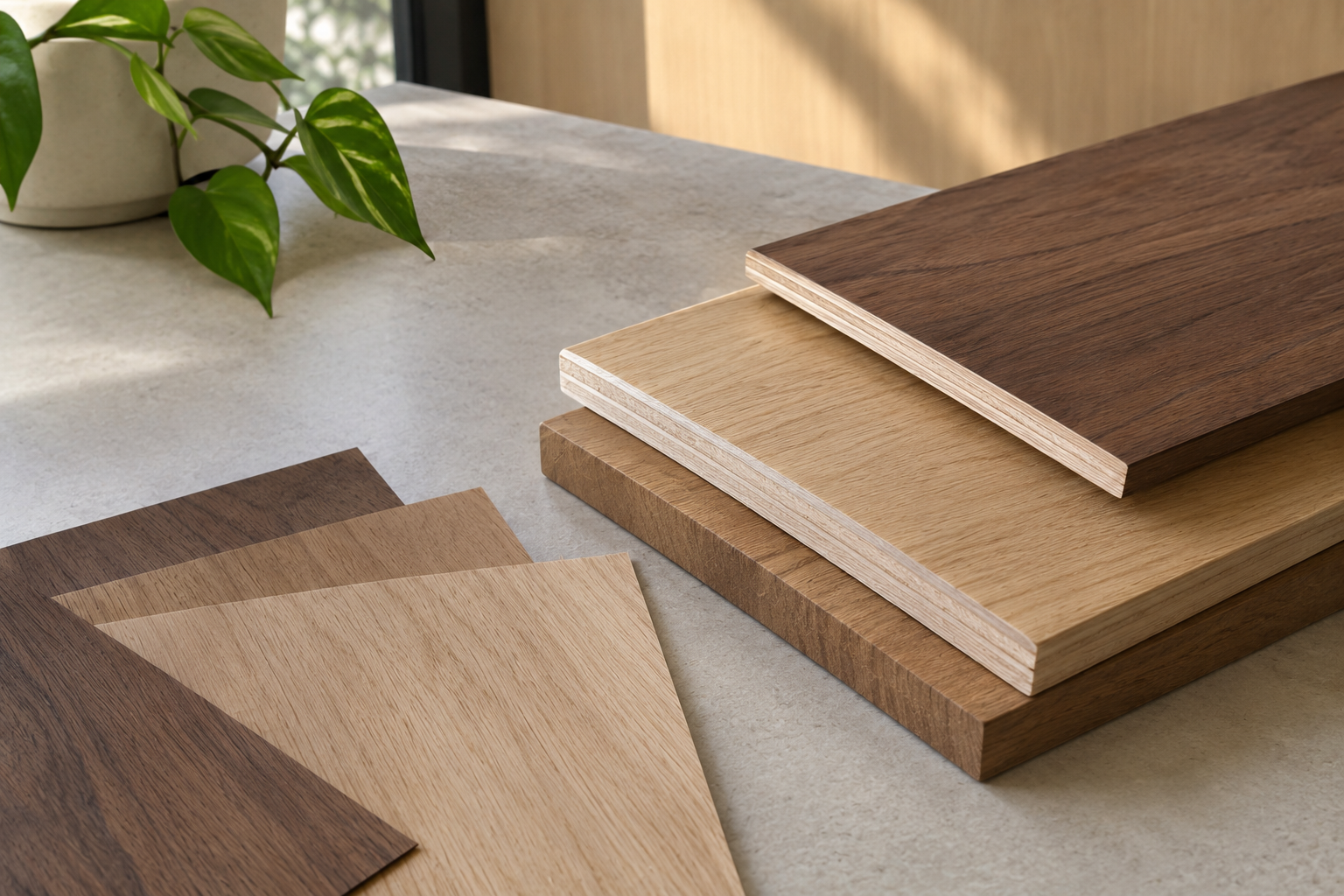
Wood veneer, solid timber and engineered timber can look almost identical on the day they are installed. A walnut cabinet face, a white oak wall panel and an oak floor all show real grain and real colour. The differences show up later: in how each surface copes with Singapore’s humidity, how it wears, whether it can be repaired, and how much timber it uses over its life.
This guide compares wood veneer with solid and engineered timber so you can choose the right material for each surface in a project. It covers what veneer is and how it is made, where it works well, where solid and engineered timber perform better, and which option is the more sustainable choice once you look beyond the first install.
A quick note on where we stand. Wood & Wood does not produce veneered panels. We specialise in solid and engineered timber, and have sourced, manufactured and supplied real-wood surfaces across Singapore for more than 30 years, including the American walnut engineered floor across a 340-room hotel. Veneer is a material our clients often weigh up against ours, so this is written as a fair comparison to help you decide.
Wood veneer is a thin slice of real timber bonded to a board, and it suits furniture, joinery, and wall panels that are looked at more than touched. Solid and engineered timber carry far more real wood, so they last longer, can be sanded and refinished, and are the better choice for floors, stairs and other high-wear surfaces.
What is wood veneer, and how is it made?
Wood veneer is a thin layer of real timber applied to a stable backing or core, such as MDF or plywood. Because the outer layer is genuine wood, it retains the timber’s natural grain, colour variation, and character.
To make veneer, a log is softened, usually by steaming or soaking, and then sliced or peeled into thin leaves. The leaves are dried, kept in the order they came off the log, and pressed onto a core with adhesive. The core provides the structure, while the veneer provides the appearance.
Veneer is often confused with laminate and melamine, but they are different materials. Laminate and melamine are printed decorative papers pressed onto a board. They copy the look of grain but have no wood on the surface. Veneer is real wood, cut from a log, with genuine figure and natural variation.
- Thickness: decorative veneer is often under a millimetre thick, compared with a wear layer of several millimetres on engineered timber and the full board thickness on solid timber.
- Core: usually plywood, MDF or particleboard. The core decides stability, screw-holding and, just as importantly, emissions.
- Supply: sold by the leaf for a joiner to lay, or as pre-laid panels ready for fabrication.
Wood veneer vs engineered timber vs solid timber vs laminate
All three wood options give you a real-wood surface. What separates them is how much wood sits on top, and that decides lifespan, repairability and where each one belongs.
- Wood veneer: a thin slice of real wood on a board core. It can be lightly refinished at most, stays flat in humid conditions because the core holds it in shape, and suits furniture, joinery, doors and wall panels. It gets the most surface out of each log, but it is glued to a composite core and is hard to reuse.
- Engineered timber: a real-wood wear layer of several millimetres on a multi-layer core. It can be sanded and refinished depending on the wear layer, the layered core limits movement in humidity, and it suits floors, wall and ceiling panels and other large areas. It uses less premium hardwood than solid timber and has a long service life.
- Solid timber: one piece of timber through its full thickness. It can be sanded and refinished several times over its life, but it moves with humidity, so it needs acclimatising and correct installation. It suits floors, stairs, worktops and heirloom furniture, has the longest life, can be resized and reused, and has no core adhesive.
- Laminate or melamine: a printed decor film on a board, with no real wood on the surface. It cannot be refinished, handles humidity well but swells at the edges if water gets in, and suits budget fit-outs and back-of-house areas. It uses little timber, but it has a short life and cannot be repaired.
Laminate is included for reference because it is the material most often mistaken for veneer. The rest of this guide focuses on the three real-wood options.
Where wood veneer works well
Veneer suits vertical, low-wear surfaces where large areas need consistent grain, such as joinery, doors, wall panels and cabinet faces.
A wide solid panel can move and cup as humidity changes, while a veneered panel stays flat because the core holds it in shape. It is also lighter than solid timber, which helps with tall wall panels and large door leaves.
- Grain matching: leaves cut in sequence from one log can carry continuous figure across a row of doors or a whole wall.
- Rare species and figured cuts: timbers that would be costly or wasteful in solid become practical as veneer, although classics such as Burmese teak are still best enjoyed in solid.
- Cost: usually lower than solid timber for the same look, and the gap widens on large or highly figured surfaces.
- Rated doors: a veneered face over a fire-rated or acoustic core gives a real-wood look on a door that still has to meet its rating.
How veneer is cut and matched also shapes the result. Crown cut gives a cathedral grain, quarter cut a straight stripe, and rotary cut a wide, variable figure. Book match mirrors each leaf, slip match repeats i,t and random match avoids a visible pattern. If you do choose veneer, ask for a sample leaf from the actual flitch rather than a catalogue image, as the same species varies from log to log. Reconstituted veneer, made from fast-growing timber that is dyed and re-laminated, gives a very uniform figure but loses the natural character of the original log.
Where solid and engineered timber outperform veneer
Floors, stairs, worktops and any surface that takes daily knocks need more real wood than veneer can offer. This is where solid and engineered timber come in.
Veneer’s main limitation is depth. A deep scratch, a dent or a chipped edge can go straight through to the core, and the face cannot be sanded back the way solid timber can. Repairs usually mean a patch or a replacement panel. With solid timber, you can sand out the same damage and refinish it, and the surface can last for decades.
- Floors: decorative veneer is too thin to walk on. Our engineered timber range uses the same real-wood-over-core idea with a much thicker wear layer, which makes it well suited to large floor areas in Singapore’s climate. We compare the two floor options: engineered timber versus solid wood floors.
- Stairs, worktops and heavy-use areas: these take constant wear and benefit from solid timber, which can be refinished many times over its life.
- Wall and ceiling features: where you want the depth and texture of real timber rather than a flat panel, timber ceiling clads give a solid-wood finish that can be maintained in place.
- Edges and corners: a solid timber edge or lipping survives knocks that would chip a veneer edge.
If you are planning a floor, our guide to specifying engineered wood flooring in Singapore covers wear layers, cores and finishes in more detail.
Which is more sustainable: wood veneer, solid or engineered timber?
Veneer gets the most surface area out of each log. Still, solid and engineered timber usually come out ahead once you account for lifespan, repairability, indoor air quality and end of life.
Sustainability is often judged on how much timber goes into a product on day one. A fairer comparison looks at the full life of the surface.
- Timber yield: slicing a log into thin leaves covers far more area than sawing it into boards, so veneer uses less premium hardwood per square metre. Engineered timber sits in between, as the decorative species forms only the top layer and the core can use faster-growing timber.
- Lifespan: a surface that lasts longer avoids the material, energy and waste of replacing it. Solid timber can be sanded and refinished several times, and good engineered timber at least once, while worn veneer usually has to be replaced.
- End of life: solid timber can be cut down, re-milled and reused. Veneered boards are glued to a composite core, which makes them much harder to reuse or recycle.
- Indoor air quality: Singapore’s National Environment Agency lists composite woods and adhesives among the building products that may contain formaldehyde. Check the core and glue in a veneered panel. Solid timber has no core adhesive, although the finish still matters.
- Certification: whichever material you choose, ask for FSC or PEFC chain-of-custody certification so you can trace the timber back to a responsibly managed forest.
- Carbon storage: wood holds the carbon it absorbed while growing for as long as it stays in use, so the longer a timber surface lasts, the longer that carbon stays locked away. At building scale, mass engineered timber applies the same principle to structure.
On emissions, Singapore’s Ministry of Sustainability and the Environment says products certified under the Singapore Green Labelling Scheme or the Singapore Green Building Product scheme have low or undetectable formaldehyde. Interior paints containing formaldehyde have not been allowed for sale since 1 January 2026, and NEA is reviewing requirements for other interior building products. As a result, low-emission materials are likely to move from good practice to requirement.
Wood & Wood works as a one-stop sustainable timber hub, from sourcing responsibly managed timber to manufacturing solid and engineered ranges built for a long service life. For most projects, the most sustainable surface is the one you will not need to replace.
Checklist for specifying a wood surface that lasts
Whatever material you choose, confirm the species, construction, finish, edges, emissions and certification before you sign off a sample.
- Species and cut: confirm the species, cut and grade against a physical sample, not a catalogue image.
- Construction: for veneer, check the core type. For engineered timber, check the wear layer thickness. For solid timber, check the board size and moisture content.
- Finish: choose lacquer, oil or hardwax oil, from matt to gloss, based on the use and how easily it can be maintained.
- Edges: specify matching edgebanding or a solid timber lipping on exposed edges, where damage shows first.
- Emissions: ask for a low-formaldehyde core and adhesive with a test certificate, or a Singapore Green Label or SGBP-certified product.
- Certification: request FSC or PEFC chain-of-custody documentation when you need to show responsible sourcing.
- Refinishing: confirm how many times the surface can be sanded and recoated over its life.
Let’s find the right timber surface for your project
Share the surface or piece you’re working on, your preferred timber species and finish, and how much daily wear it needs to withstand. Wood & Wood can recommend a suitable solid or engineered timber option, including species, construction and finish, based on your design and practical needs, with an initial recommendation provided within one working day.
Get in touch with our team or visit our showroom to see and handle the timbers in person.
Frequently asked questions
Is wood veneer real wood?
Yes. Wood veneer is a thin slice of real timber, so it shows natural grain and colour. Laminate and melamine are printed films that only imitate wood.
Is wood veneer better than laminate?
For appearance, yes. Veneer is real wood with natural variation and can be lightly refinished. Laminate resists scratches and moisture at a lower cost, but it cannot be repaired and has no real timber on the surface.
Can wood veneer be sanded or repaired?
Only lightly. Because the real-wood layer is often under a millimetre thick, heavy sanding can go through to the core. Serious damage usually means patching or replacing the panel.
Can wood veneer be used for flooring in Singapore?
Decorative veneer is too thin for floors. For a real-wood floor that copes with Singapore’s humidity, engineered timber with a thick wear layer or properly installed solid timber is the better option.
Which wood surface is the most sustainable?
Veneer uses the least timber per square metre, but solid and engineered timber usually perform better over the full life of the surface because they last longer, can be refinished and, in the case of solid timber, reused. In every case, look for FSC or PEFC certification and low-emission products.
Does Wood & Wood supply wood veneer?
No. Wood & Wood does not produce veneered panels. We specialise in solid and engineered timber and can advise whether one of these would suit the surface you are planning.